Article — August 23, 2026
How Engineers Bend Light Like Carving Through Stone
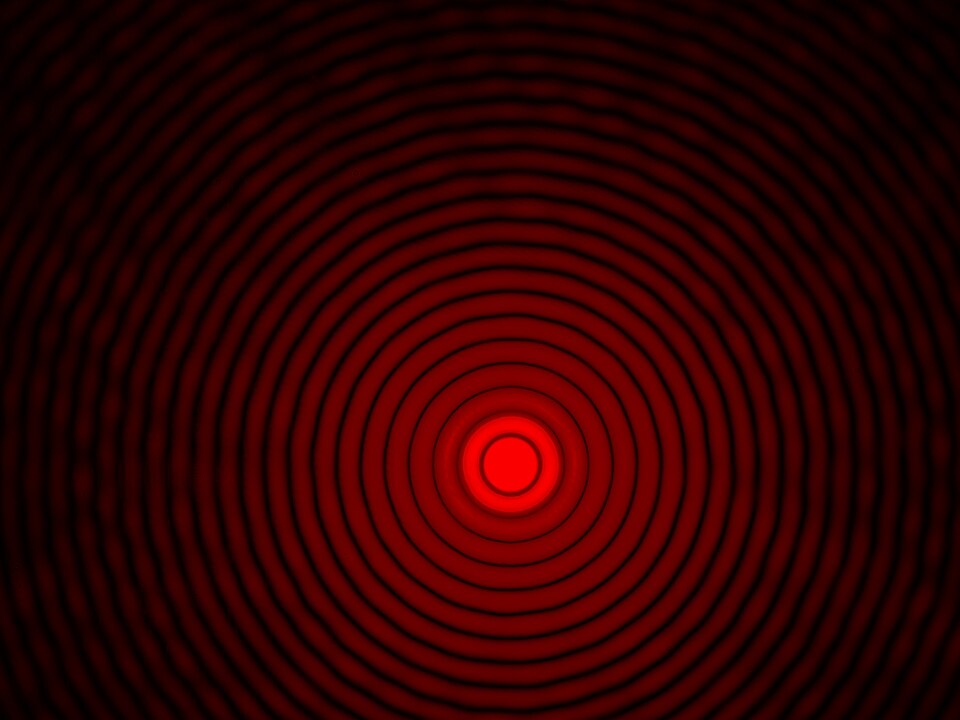
Optical engineering and signal processing appear as completely disparate fields within electrical engineering. In fact, this cannot be further from the truth. There’s actually a subset of optical engineering that utilizes the Fourier transform as a framework for analyzing light propagation and image formation, known as Fourier optics. While not delving too deep into this topic, there’s an elegant comparison to be made for the way in which optical engineers design complex optical systems. First, I think it’s important to give some background information for why this is the case.
Optics is fundamentally about bending light and manipulating its wavefront for applications such as imaging systems. These systems are completely analog, even if they are designed using simulation software.
Signal processing, on the other hand, can be implemented through analog hardware or through software; the latter is often preferred for complex algorithms due to the noise immunity of binary. Digital implementations of signal processing are typically focused on extracting or relaying information to and from the real world, whereas analog implementations typically involve signal conditioning against noise for transmission or anti-aliasing. Signal processing is almost overwhelmingly a digital domain, with exceptions made for instances where it’s cheaper to have an analog filter than a high-speed ADC.
So where’s the connection?
Light is a time, space harmonic signal. As with any signal, it can be decomposed using a trigonometric (or complex exponential) basis, and its frequency content can be analyzed.
Let’s consider the example of a pinhole camera for coherent light and an object point on the optical axis. What does our system look like? A single aperture and an image plane.
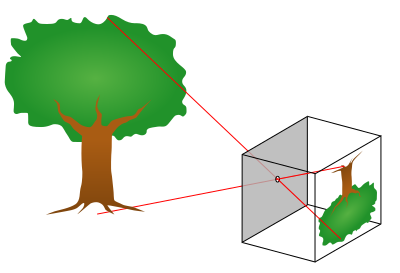
If we zoom into the aperture, we can assume that every contained point has uniform energy. In 2D, this is the mathematical equivalent to a rectangular function. Everywhere inside the aperture has equal amplitude, and everywhere outside the aperture is zeroed out.
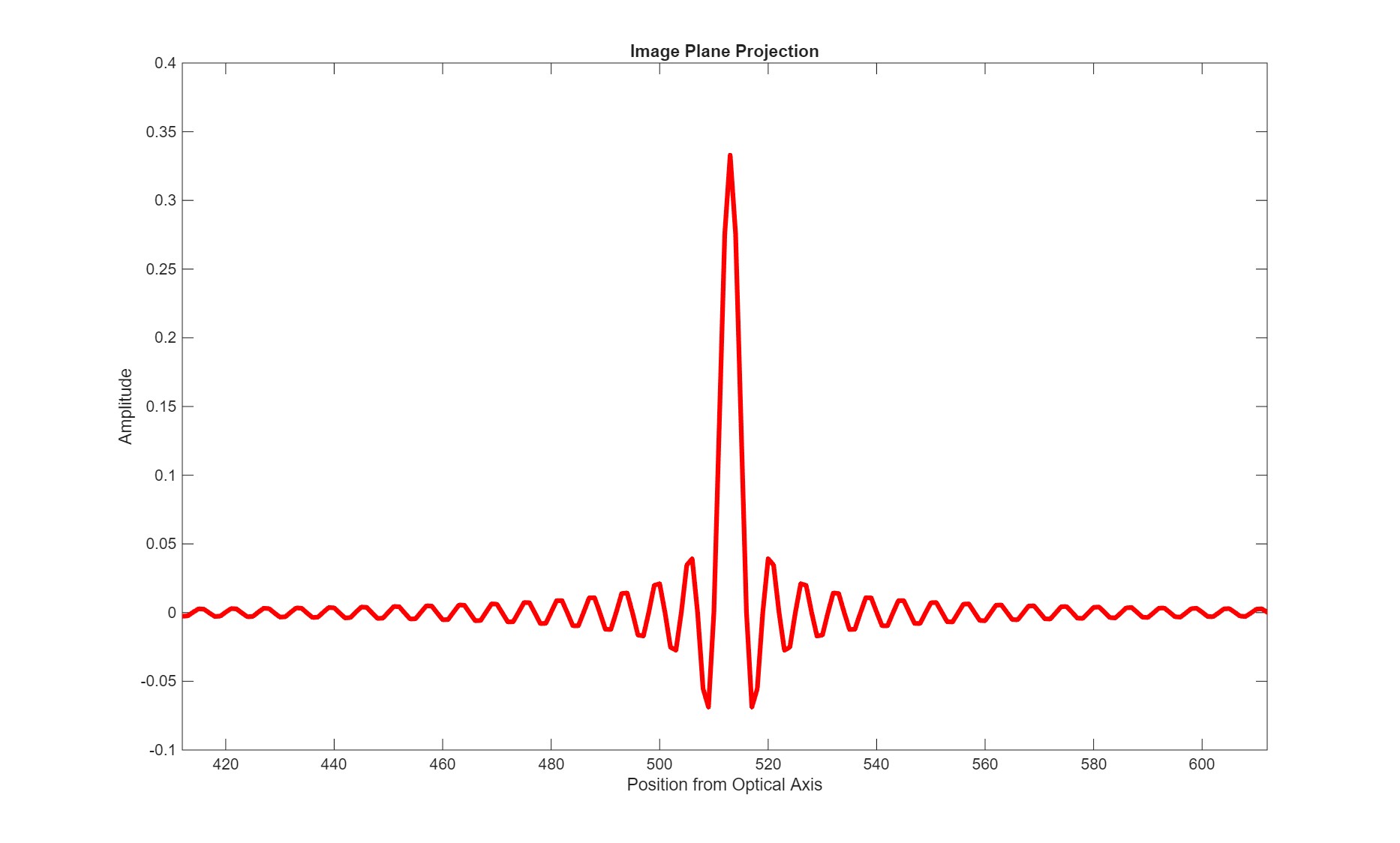
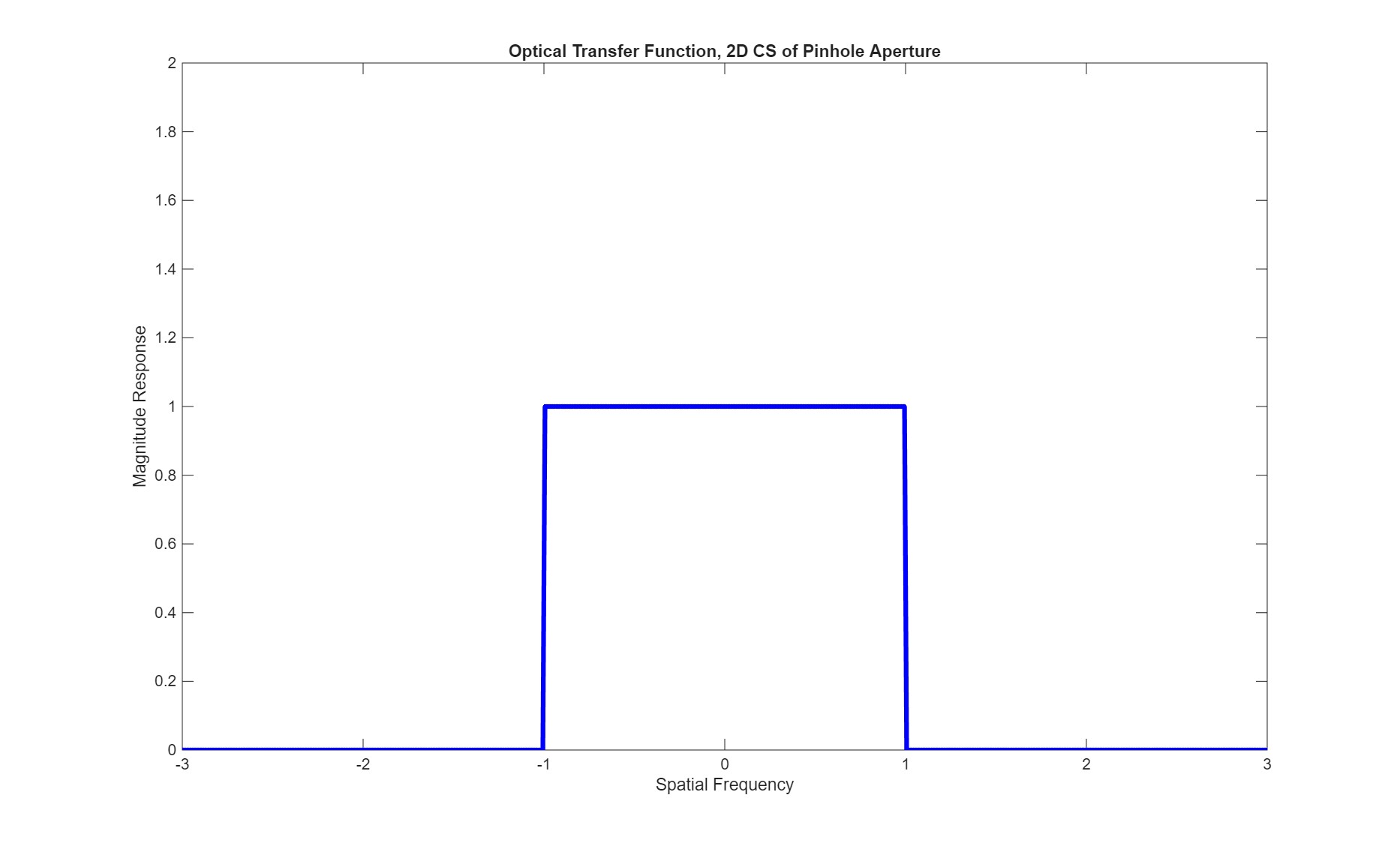
But we don’t care what the energy distribution looks like at the aperture. Whatever’s at the image plane is of more practical value. We have two options for solving the image imprinted on the back plane: Huygens’ principle or an inverse Fourier transform.
Huygens’ principle is more of a hypothetical model that states that every point on a wavefront is a source of spherical wavelets, whereas the inverse Fourier transform just leverages the observation that the aperture can be formulated as a rectangular function. Both are consistent with each other; both are mathematically the same solution but with distinct origins.
The result is a sinc function centered on the optical axis. If we want to know what it looks like for an object point off the optical axis, we can incur a phase shift in the spatial frequency domain that corresponds to a shift in position in the image plane.
This Fourier relationship has an interesting consequence. In the same way that Heisenberg’s uncertainty principle states that the product of position and velocity are constrained by a finite quantity, the time-bandwidth product is constrained by a finite quantity as well. The size of the aperture is inversely related to the spot size (or beam waist).
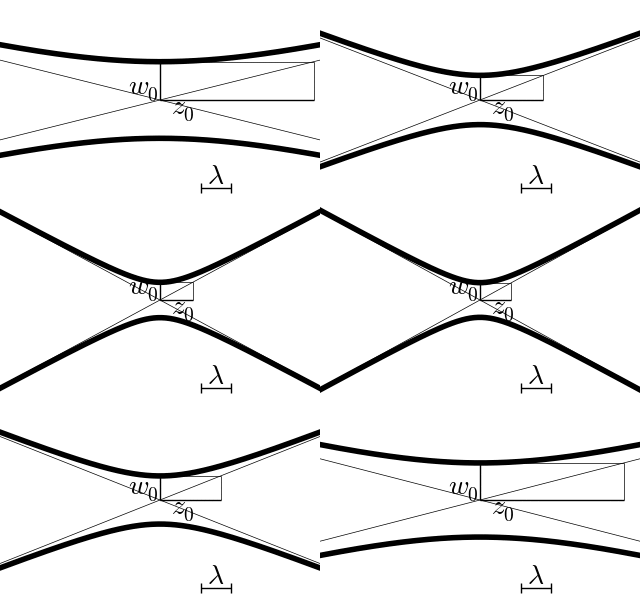

Increasing the aperture diameter for a fixed focal length tightens the focus. It produces a smaller waist/spot radius, along with a shorter Rayleigh range (lowering depth of field), while also increasing the divergence angle. The converse is also true: decreasing the aperture diameter yields a larger spot, smaller divergence angle, and a longer Rayleigh range.
I’m harping on this point because of its enormous practical value. It describes the fundamental upper limit to imaging systems and the tradeoffs that optical engineers have to manage.
Key Result
What this ultimately amounts to is this: optical engineers design lens systems to minimize aberrations, thereby suppressing the side lobes incurred by the sharp edges of the aperture stop. Through apodization, essentially pulse-shaping in telecommunications, they construct the optical transfer function to appear more Gaussian. The Fourier transform of a Gaussian is another Gaussian. The Gaussian profile has no side lobes, preventing the diffraction pattern that plagues pinhole cameras.
In a sense, optical engineers are like Renaissance sculptors. They take a block of marble (i.e. rect function) and shape it into something that is way smoother. This is how optical engineers bend light like carving through stone.